
What Is a Domain? What to Consider When Buying One
What Is a Domain?
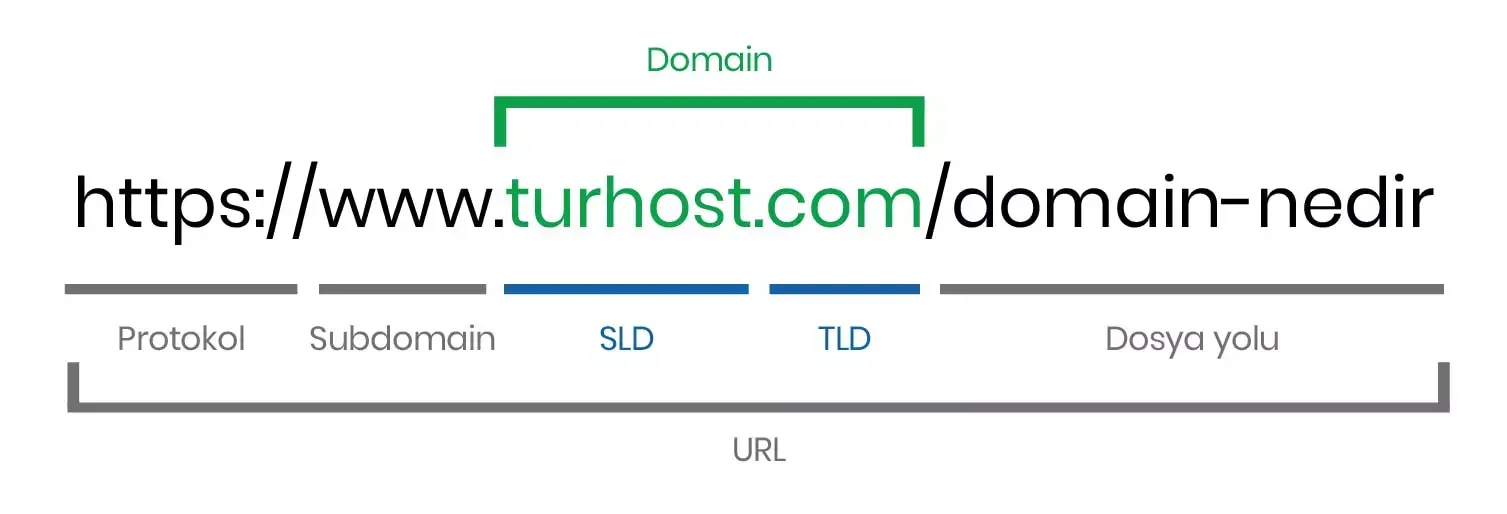
A domain name can be defined as the string that identifies a website's address and that users type to reach the site. For example, the domain name www.example.com contains the domain name "example.com". Domain names usually end with a suffix (for example, .com, .org, .edu), and these suffixes are used to identify different types of sites on the internet.
What Is Domain Registration?
Domain registration, also known as a domain, is the process required to use the domain name that identifies a website's address. In this process, it is checked whether the domain name exists and, if so, who is using it. If the domain name is not in use, a person or organization can purchase it and become entitled to register it. Domain registration is usually carried out through a domain registrar. These companies carry out all the operations needed to register and manage domain names.
Why Is a Domain Name Important?
A domain name is an important component that defines a person's or business's identity on the internet and allows users to find their presence online. A domain name is important for the following reasons:
- Brand identity: The domain name defines the identity of a business or person on the internet and reinforces brand identity.
- Findability: The domain name allows users to easily find your presence on the internet.
- Trustworthiness: The domain name shows that your business or personality is reliable and helps earn users' trust.
- SEO: The domain name can be used as a keyword for search engines and is important for SEO.
- Email: An email address matching your domain name makes your business or personality look more professional.
- Online advertising and marketing: The domain name is important for your online advertising and marketing activities and allows users to easily find your presence on the internet.
What Is a Domain Extension?
A domain extension is the suffix at the end of a website's address. For example, the extension of www.example.com is .com. Extensions are used to identify different types of sites on the internet. For example, .com is used for general-purpose sites, .edu for educational institutions, .gov for government institutions, and .org for civil society organizations.
A domain can be obtained through a domain registrar, and only for extensions that are available. The WHOIS lookup tool can be used to check whether a domain name is available.
Which Domain Extension Should Be Used for Which Project?
Which domain extension should be used for which project may vary depending on the purpose and target audience of the project. However, in general, extensions can be classified by their usage as follows:
- .com: The most widely used extension for general-purpose sites. It is the most suitable extension for commerce, e-commerce, or businesses.
- .net: Used for sites related to technology and internet services.
- .org: Used for civil society organizations, private institutions, or non-profit organizations.
- .edu: Used for educational institutions.
- .gov: Used for government institutions.
- .info: Used to provide information.
- .biz: Used for businesses.
- .co: Used for general-purpose sites.
- .me: Used for personal blogs or portfolios.
Country-code domain (ccTLD: country-code Top Level Domain) is a two-letter top-level extension in internet addresses that indicates the country. For example, in the address www.istanbul.com.tr, ".tr" represents Turkey's country-code internet domain. Similarly, this code is ".ru" for Russia and ".it" for Italy. Not every internet address has a country code. The country-code top-level domain is one of three types of top-level domain extensions, used together with generic top-level domains (gTLD) and infrastructure top-level domains (iTLD). These extensions are determined by IANA, an organization under US oversight.
What to Consider When Buying a Domain
- Relevance: Your domain name should reflect the description of your business or brand.
- Short and easy to understand: Your domain name should be easy to remember and to type.
- Uniqueness: You should choose a unique domain name, since the same domain name may be used by another person or organization.
- Length: Short domain names are generally easier to remember and type.
- Extension: Pay attention to whether the extension (.com, .net, .org, etc.) is appropriate. For example, for an educational institution, the .edu extension may be more suitable.
- Search engines: Your domain name should be chosen so that it can include keywords and perform well in search engines.
- Copyright: Make sure your domain name does not infringe on the copyright of another person or organization.
- Affordable price: The cost of a domain name can vary depending on your budget and needs.
https://www.eticaretteyim.com/kurumsal-mail-nedir-kurumsal-mail-nasil-alinir/
https://www.eticaretteyim.com/eticaret-hosting-nedir-ne-ise-yarar/
https://www.eticaretteyim.com/kurumsal-mail-nedir-kurumsal-mail-nasil-alinir/
https://www.eticaretteyim.com/domain-nedir-domain-alirken-neye-dikkat-etmek-gerekir/
eticaretteyim Yönetici
We create easy-to-follow guides for store owners on e-commerce, hosting and business email.
Was this post helpful?
Comments
No comments yet. Be the first to comment.
Leave a comment
Comments are published after approval. Your email address is never shown on the site.
Related posts

Can AI Create Your Product Images?
In e-commerce, the most important factor in a customer’s buying decision is the product image. Is it logical to have AI create product visua...

AI-Powered E-commerce
AI-Powered E-Commerce: A New Era in Digital Trade. Among the most dynamic areas of digital transformation, e-commerce undoubtedly stands out...

Is It Good to Write Product Descriptions with Artificial Intelligence?
Competition in the e-commerce world is becoming harder by the day. One of the most powerful weapons to stand out among thousands of products...

Artificial Intelligence and E-Commerce
Artificial Intelligence and E-Commerce: How to Get Ahead in the Future of Trade? We are living through one of the most exciting periods of d...